
..........................................................................................................................................................................................................
the cycling addiction. suffering, speed and the search for meaning on two wheels. phil cavell bloomsbury sport paperback. 320pp illus. £18.99
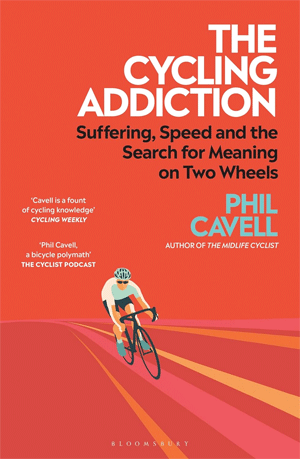
"Hi, my name is Phil. And I am a cycling addict."
phil cavell is one half of the owners of london's cyclefit where i was once invited to undergo a bespoke bike fit in order to prepare an article for thewashingmachinepost. the outcome of that particular bikefit was eye-opening, to put it mildly. my saddle height, in particular, was based almost entirely on the trend of the day to ride with your posterior in the air, while my teeth almost crunched the stem. in hindsight, those contortions were akin to recalling the flares i used to wear as a teenager. according to mr cavell's detailed notes, i had spent a large part of my career to that point, riding with my saddle almost four centimetres higher than the bikefit recommended. convinced that there must be some mistake - a few millimetres would not have seemed inordinate, but four centimetres? - i set the saddle to mr cavell's designation and i have ridden in (relative) comfort ever since.
which is a very long-winded way of saying, i have every faith in phil's velocipedinal ministrations on our behalf.
his previous foray into print - the midlife cyclist - examined the available opportunities for those over fifty to continue training hard, riding fast, while remaining healthy. this time, as the book's subtitle suggests, the author takes a closer look at why we desire speed on our bicycles and the often uncomfortable hoops we're willing to jump through in order to get there. in other words, why are some indiviuduals more drawn to pain and suffering than others? encapsulated in the first paragraph of the introduction, "racing bicycles has never been about avoiding pain, merely weighing it." it's not necessarily that we're attracted to the pain and suffering, but many are willing to accept it, providing they appear to be dishing out greater amounts of it to those against whom they race. as a principal focus maintained as a background to the book's philosophy, mr cavell cites possibly one of the sport's most iconic novels, the rider, by tim krabbe.
at this particular point, might i suggest that, if you haven't already experienced the rider, that you acquire a copy along with the cycling addiction. you won't regret it.
and to be almost perfectly on topic, for those who witnessed tadej pogacar winning atop alpe d'huez, in the process, reducing a three minute gap to nothing in a matter of very steep, uphill kilometres, one can only imagine the pain and suffering endured not only to achieve that stage win, but the amount he must have endured in training to be able to put on such a dominant display in the first place. that goes every bit as much for those who were left flailing in his wake.
why?
cavell uses the witnesses of robert millar, adrian timmis ("frighteningly normal on the outside but other-worldly on the inside.") the latter description of which could be applied to many, if not all of us, whose first reaction to a crash would always be "is the bike ok?". phil cavell asks many of the questions that some of us have already asked, put in a far more organised and logical fashion. others may be still to reach that point. "Why am I like this? Where does my compulsion to ride come from?" if those are questions you'd prefer not to ask at present, the author has dedicated this book to doing so, in order that you don't have to. and first on the list is an examination of what he has entitled 'project pain', elucidating that its origins lie in millennia past, when its purpose was to protect animals - and, by implication, us - from injury or death. he concludes that, despite its aim to keep us safe from ourselves, certain lycra wearing animals seek, venerate and trade it as if it were a commodity to be embraced.
to understand this in greater detail, the author introduces us to 'the thing', otherwise known as the cyclist's brain. it is arguably this 'thing' that has given rise to a cycling genotype, the origin of which, cavell dates accurately to 1869 "...the world's first recorded bicycle road race from Paris to Rouen." i cannot deny that i skipped through most of the chapter on the brain, finding it uncomfortable to use the very organ i was reading about, to comprehend that which mr cavell was (metaphorically) disseminating.
but that's just me. i can't watch those medical programmes on tv either.
deliberately (i believe), phil uses the example of the match-burning frank vandenbroucke to describe what can go wrong when skill and ambition don't quite match up with appropriate human perspective. vandenbroucke had, as his biographer andy mcgrath wrote in 'god is dead', "lived his life without a parachute".
it would be a spurious endeavour for this reviewer to recount all the impressive research, awareness, intellect and skill that the author has invested in a detailed and occasionally controversial examination of why it is that we do what we do, irrespective of how well we actually do it. the narrative provides a clear, concise explanation of what would otherwise be complex and often obscure concepts and the terminology adopted to describe them. reading all 300 plus pages might not transform you into krabbe's rider, nor indeed, robert millar or adrian timmis, but that's hardly the real point. it might take a couple of read throughs to acquire a true picture of what keeps persuading me to occasionally overstretch myself on the sunday ride, but if nothing else, it should give me a convincing answer for the fellow in debbie's who keeps asking me why on earth i slog myself silly into horizontal rain and galeforce winds.
it'll work for you too. superb is scarcely an adequate description.
thanks to the generosity of bloomsbury sport, i have one copy of 'cycling addiction' to send to the winner of this simple competition. what was the title of phil cavell's previous book? send answers, along with a full postal address, to brian@twmp.net closing date is monday 3 august.
wednesday 29 july 2026
 ..........................................................................................................................................................................................................