
..........................................................................................................................................................................................................
handcrafted bicycles: builders, frame design, and inspiration. christine elliot & david jablonka. schiffer publishing hardback. 256pp illus. £45.99
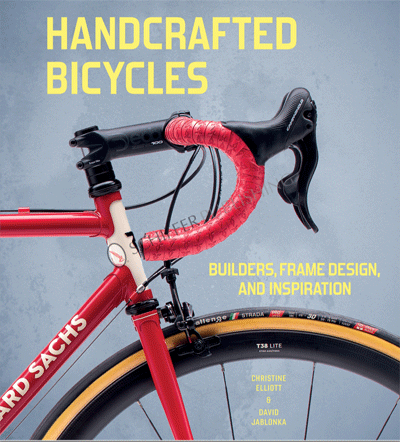
from around the middle of the first decade of the 21st century, the profile of the handbuilt bicycle almost suddenly became a thing. in 2005, the north american handbuilt bicycle show first reared its head in richmond, virginia, allowing the new breed of frame builders to exhibit their wares, effectively re-establishing a tradition that had all but been subsumed by the wholesale shift to mass-market carbon fibre. admittedly, over time, one of two of those at the vanguard of the movement subsequently explored the possibilities of handbuilt carbon, but in the main, steel was the weapon of choice.
there are several reasons for this, but likely settled on the fact that, relatively speaking, steel is cheap and readily available, as are the tools required to transform tubing into bicycle frames, and the resultant product is strong, sturdy and easily repairable. it should probably also be pointed out that, with a bit of initiative, building with steel could be managed in a garage space, without the need to rent substantial premises.
during my first trip to portland, oregon, i visited several workspaces which were rudimentary at best, yet perfectly adequate for the purpose.
it wasn't too long before the desire arose to handbuild bicycle frames on this side of the atlantic, leading to the establishment of bespoked bristol (subsequently shortened to bespoked) in an annexe of bristol railway station. the popularity of such a venture can perhaps be gauged by the fact that the expo was once held in the olympic velodrome in london, attended by the man who re-invented the headset, chris king.
unless you happen to be in the market for a handbuilt, custom bicycle frame, you might be forgiven for thinking that the euphoria had diminished to the point of dissolution. but you'd be wrong, something that christine elliot & david jablonka have effectively proved beyond question in their substantial tome, handcrafted bicycles. the research for this large publication must surely have occupied a great deal of time, with 32 builders highlighted from seemingly every corner of the world. accompanying each chapter is a copious number of illustrations showing not only the differences, but in effect, the similarities between bicycles hailing from a total of thirteen countries, including north america, the uk, france, the netherlands and several other nations. i'm not entirely sure what that actually proves, but it does highlight that a bike, is a bike, is a bike, no matter its country of origin.
the non-believer might well question the purpose behind the book; mrs washingmachinepost most certainly would, having claimed on several occasions that "it's only a bike". the authors quote respected uk builder, richard hallett as saying, "A metal frame, two wheels, pedals, a seat, and handlebars - on first glance, bicycles look pretty straightforward." depending on your point of view and indeed, that of the builder, creating bicycle frames can be considered a trade, profession, artistry, craftsmanship, or fabrication. either way, you hopefully end up with a bicycle that suits your sense of aesthetic and purpose. how much that costs, depends on a wide variety of factors; price is one of the factors never mentioned within the book.
many of the builders cite similar reasons for pursuing this particular line of work: " i strive to have a client engaged in their frame from conception to hand-off"; "it's gratifying when a customer can come pick up their bike in person"; "when they receive the bicycle in person, you can see in their eyes the reward of this journey." but where the majority detail their love of bicycles and the paths that led them to become framebuilders, demonstrating a not unexpected similarity in many cases, the one who stands out in this respect is richard sachs, the chapter on whom begins, "I didn't want to be a bicycle maker; I became one,"
"To make a better bicycle so that those in whose corners I sit will have the best tool for the job."
there is, of necessity, a repetition across the book's chapters, yet the authors appear content to leave the reader to draw their own conclusions (assuming there are conclusions to be drawn) as to why the handbuilt bicycle still exists. is it because there are those who see it as their life's obsession to make bicycles, or because there persists a desire on behalf of many of the world's cyclists to own just such a handcrafted 'tool' (to quote richard sachs)? though the narrative remains consistent across the book's 250+ pages, it's not necessarily a book that demands it be read from start to finish. it may be a case of picking and choosing dependent on taste and interest.
but even if you harbour a peloton of carbon bicycles in the bike shed, ready and willing to dispute that steel is, in fact, real, there's a certain comfort to be gained from knowing that there are still those with skills and purpose to maintain a lengthy tradition, happy to provide that which many desire, rather than settle for what the industry tells us is good for us.
handcrafted bicycles is published in the usa on 28 september and in the uk on 28 november 2025.
monday 29 september 2025
 ..........................................................................................................................................................................................................